


Last reviewed: November 16, 2026. Technical guidance from Coherent, Fraunhofer ILT, VTT and Health Canada may change. Refer to the latest official documents for current information.
An engraved serial number on a steel component, a QR code on a stainless-steel part and a name on a metal ring may all be produced with fiber-laser technology. But they do not necessarily use the same machine. Fiber laser applications range from marking and engraving to industrial cutting, welding, cleaning and precision drilling. The right system depends on the material, required result, production volume and equipment configuration. This guide explains the main processes, where they are used and how to distinguish a desktop fiber engraver from an industrial processing system.
What Does a Fiber Laser Do?
A fiber laser generates light in an optical fiber whose core is doped with rare-earth ions. Ytterbium-doped sources are common in near-infrared industrial processing. Many metal-marking sources operate near 1064 nm, although that wavelength is not universal to every fiber laser. Coherent’s technical overview describes rare-earth-doped fibers producing near-infrared output across the 1–2 μm range, with material-processing applications that include drilling, cutting, welding and marking (Coherent’s rare-earth-doped fiber white paper).
At the workpiece, a focused beam transfers energy to a small area. Depending on the source, pulse format, optics, power, focus and material, the interaction can change the surface, remove material or create a melt pool. The laser source is only one part of the system: a galvo head, cutting or welding optics, motion platform, assist-gas supply, controls and safety equipment determine what the complete machine can do.

For a broader introduction to the source and beam-delivery process, read Monport’s fiber laser technology guide.
What Are the Main Fiber Laser Applications?
1. Fiber Laser Marking and Product Identification
Fiber laser marking creates a visible mark or contrast on a material’s surface. Depending on the material and process, the result may come from localized heating, oxidation, surface structuring or shallow material removal. Typical uses include company logos, serial numbers, QR codes, Data Matrix codes, manufacturing dates, batch information and tool identification.
In manufacturing, a readable, durable mark helps connect a component with production records, inspection data and maintenance history. The mark must suit the material and the conditions the part will face. A code that looks clear on a sample may not remain readable after abrasion, cleaning or exposure to heat, so production applications should be validated on the actual material and finish. Fraunhofer ILT describes application-specific laser marking for metals, plastics and paper, including the role of adapted optics and process modelling (Fraunhofer ILT’s laser-marking overview).
For more on the difference between surface marks, coating removal and true metal engraving, see Monport Canada’s fiber laser metal-marking guide.
2. Fiber Laser Engraving and Deep Engraving
Engraving removes material to create a recessed design. It is used for text, logos, decorative patterns, tool identification, nameplates and personalized metal accessories. Marking and engraving are sometimes used loosely in product descriptions, so the required result matters more than the label: do you need a surface contrast, a shallow texture or a measurable recess?

Engraving depth is not determined by wattage alone. Average power, pulse energy, pulse duration, repetition rate, scan speed, focus, line spacing, material properties and the number of passes all influence the result. A deeper mark may require more material removal and additional passes, which can affect cycle time, edge quality and heat input. Not every desktop fiber engraver is intended for heavy deep engraving or continuous industrial production.
3. Fiber Laser Annealing and Colour Marking

Laser annealing uses controlled heating to change a metal’s surface appearance without necessarily removing a significant amount of material. On suitable metals, this can create dark or contrasting marks. Colour marking is a more specialized process. On selected stainless-steel and titanium surfaces, controlled surface oxidation or optical effects can produce visible colours.
MOPA (Master Oscillator Power Amplifier) is a pulsed-laser architecture. A technical paper on MOPA pulsed-laser architecture describes the seed-oscillator and amplifier stages in a pulsed-fiber system. On MOPA sources designed for it, pulse width and repetition frequency can be adjusted independently, giving the process more flexibility than a fixed-pulse source. JPT’s MOPA documentation describes this independent control for marking and surface processing (JPT M7 MOPA fiber-laser specifications).
Colour is not guaranteed on every metal or finish. A 2026 study of AISI 304 stainless steel found that scanning speed, raster spacing, overlap and pass strategy affected colour contrast and surface roughness under the tested conditions (the AISI 304 laser-marking study). Those results should not be treated as universal settings for other alloys, coatings or machines.
4. Fiber Laser Metal Cutting
Fiber laser cutting uses a focused beam to melt or vaporize material along a defined path. An assist-gas jet helps remove molten material from the cut. Industrial cutting systems need a suitable laser source, cutting head, motion platform, gas supply and process controls. The required configuration depends on the metal type, thickness, cut geometry and quality target.
Cut quality is a process-window problem, not a wattage contest. In a peer-reviewed study using a 5 kW fiber laser to cut stainless-steel plate and aluminium sheet, researchers examined laser power, cutting speed, focal-point position and assist-gas pressure because each affected cutting performance and surface quality (VTT’s fiber-laser cutting study). A desktop pulsed fiber engraver is not a substitute for an industrial sheet-metal cutting system.
5. Fiber Laser Welding
Laser welding joins metal components by concentrating energy at the joint and creating a molten weld pool. Fiber lasers are used in industrial fusion-welding systems for suitable metals, including steels and selected aluminium, titanium and copper alloys. The process depends on joint fit-up, material, beam delivery, focus, travel speed, shielding conditions and process monitoring.
A production welding system needs purpose-built welding optics, a processing head, fixtures, controls and appropriate safety measures. Fraunhofer ILT identifies fiber lasers among the sources used for fusion welding of metallic materials and describes process-specific optics and controls for industrial joining (Fraunhofer ILT’s laser-welding information). A desktop marking machine should not be treated as a welding system.
6. Fiber Laser Cleaning and Surface Preparation
Laser cleaning removes selected surface layers or contaminants, such as rust, oxides, coatings, oil films and particles. The process may use pulsed or continuous laser radiation. The interaction depends on wavelength, intensity, exposure time and the properties of both the contaminant and the underlying material. Cleaning is used in surface preparation before joining, coating or other manufacturing steps.
The process must remove the unwanted layer without damaging the substrate. That requires a dedicated source, optics, process settings and suitable extraction or containment. Fraunhofer ILT notes that laser cleaning can remove oxide layers and particulate or film contaminants, and that the process conditions depend on the radiation and surface materials (Fraunhofer ILT’s laser-cleaning overview). A standard desktop marking engraver is not an industrial laser-cleaning system.
7. Fiber Laser Drilling, Micromachining and Advanced Processing
Laser drilling creates holes through localized material removal. Specialized systems can produce small features in aerospace, electronics, medical technology and other precision-manufacturing applications. Ultra-short-pulse lasers are used for some microdrilling tasks, while other drilling processes use different pulse formats and motion strategies. Fraunhofer ILT describes drilling methods that cover a wide range of hole sizes and geometries (Fraunhofer ILT’s laser-drilling information).
Laser cladding and laser additive manufacturing are related but distinct processes. Cladding adds material to a component’s surface for repair or functional modification. Additive processes such as Laser Powder Bed Fusion (LPBF) and Laser Material Deposition (LMD) build or repair parts using controlled material delivery and melting. These are specialized industrial platforms; they should not be presented as ordinary functions of a desktop fiber engraver.
Which Industries Use Fiber Laser Technology?
Laser-based manufacturing appears in several sectors, but each industry uses a different combination of processes. The examples below describe common application areas; they do not mean that one fiber laser machine can perform every task.
| Industry | Typical applications | Practical purpose |
|---|---|---|
| Automotive and EV | Component marking, serial numbers, selected cutting and welding operations, battery and motor production | Identification, traceability and component joining |
| Aerospace | Part marking, selected drilling, precision processing and repair | Part identification and demanding component manufacture |
| Medical technology | Selected component marking, precision processing and micromachining | Identification and manufacture of small or detailed components |
| Electronics | Component marking, microdrilling and precision surface processing | Compact identification and controlled material removal |
| Jewelry and watches | Ring, pendant, bracelet and watch-component marking or engraving | Personalization and detailed finishing |
| Metal fabrication | Tool marking, nameplates, component engraving and industrial sheet cutting | Identification, customization and part production |
Fraunhofer ILT lists automotive engineering, battery manufacturing, aerospace, medical technology and microelectronics among the markets using laser-based processes (Fraunhofer ILT’s application-sector overview). The exact laser source and machine configuration vary by operation. A factory may use one system for permanent part marking, another for welding and a separate cutting cell for sheet metal.
What Can Small Businesses Make with a Fiber Laser?
Small workshops, jewelry studios and custom-product businesses usually focus on marking and engraving rather than industrial cutting or welding. A desktop fiber laser can support repeatable personalization on compatible metal products, provided the material, finish and machine configuration are suitable.

Personalized Jewelry and Accessories
Typical projects include names and dates inside rings, initials on pendants, logos on bracelets, watch-back markings and decorative patterns on suitable metal pieces. Curved or cylindrical parts may need a compatible rotary attachment or positioning fixture. For more on material, power and speed considerations, see Monport’s jewelry fiber-laser guide.
Custom Gifts, Drinkware and Promotional Products
Metal keychains, business cards, tags, medals, promotional items and compatible drinkware can be personalized with names, logos or graphics. Before choosing a process, check the base metal, plating, coating, surface finish and shape. A tumbler, for example, may need a suitable rotary setup and enough clearance; a coated item may produce a different result from bare stainless steel.
Tools, Nameplates and Small-Batch Branding
Fiber lasers can also mark tool identifiers, equipment labels, metal plates and branded accessories. For a small business, the value is often the ability to switch between one-off personalization and repeatable small batches. The practical limit is the machine’s working area, fixtures, required depth and production cycle—not simply its advertised maximum speed.
When comparing machines for metal work, Monport’s fiber laser for metal buying guide offers a closer look at materials, job requirements and purchasing considerations.
Pulsed vs. MOPA vs. CW vs. Ultrafast Laser Systems
The laser source format helps determine which processes a system can support. One important distinction: MOPA is a type of pulsed-laser architecture, not a separate category that sits outside pulsed fiber lasers.
| Source or architecture | Output characteristic | Common process fit | Important limitation |
|---|---|---|---|
| Pulsed fiber (for example, Q-switched) | Delivers energy in short pulses | Metal marking, engraving and selected surface processing | Results depend on pulse energy, repetition rate, focus and material |
| MOPA pulsed fiber | Allows pulse width and frequency to be adjusted independently on suitable sources | Flexible marking, selected colour effects and surface processing | Pulse control does not guarantee a particular colour or finish |
| Continuous-wave (CW) fiber | Delivers a continuous beam | Industrial metal cutting and welding with a dedicated system | Requires suitable power, optics, motion control and auxiliary equipment |
| Ultrashort-pulse systems | Uses very short pulses, such as picosecond or femtosecond pulses | Specialized microdrilling and precision micromachining | A specialized platform, not a standard desktop marking setup |
The best source is the one that fits the required result and production conditions. A MOPA system may be useful when a workshop needs more control over pulse characteristics and surface effects. A CW system is more relevant to many industrial cutting and welding cells. Neither architecture is automatically the best choice for every material or job.
How to Choose a Fiber Laser for Your Application
- Identify the result first. Decide whether you need surface marking, a recessed engraving, a colour effect, a cut-through edge, a weld joint or contaminant removal. These are different processes and may require different equipment.
- Confirm the material. Record the alloy, thickness, coating, plating, finish and any surface treatment. “Stainless steel” or “aluminium” alone may not be enough to predict the result.
- Define the quality target. Set the required contrast, readability, depth, colour consistency, edge quality and dimensional tolerance. Validate on the actual material rather than assuming a result from a generic sample.
- Match the source and machine architecture. Consider pulsed, MOPA, CW or ultrashort-pulse technology as appropriate. Then check the optics, working area, motion system, assist gas, fixtures and any rotary attachment.
- Estimate production needs. Compare part size, batch size, changeover time, number of passes and expected duty cycle. A larger work area or higher maximum speed does not automatically mean higher finished-part output.
- Review software and safety requirements. Check file workflow, machine compatibility, enclosure design, interlocks, labels, user instructions and the laser hazard classification. In Canada, Health Canada’s laser-product guidance explains classification, engineering safety features and user-information requirements (Health Canada’s laser-product guidance). Never bypass safety features; follow the manufacturer’s instructions and applicable workplace requirements.
For Canadian commercial workshops, employers should assess laser-beam and reflected-radiation hazards, fumes, fire risks, and other workplace conditions, then follow the occupational health and safety requirements that apply in their jurisdiction. Health Canada’s product requirements and CCOHS workplace risk-assessment guidance serve different purposes; CCOHS guidance is not, by itself, a substitute for applicable legislation.
Where Monport Fiber Laser Engravers Fit
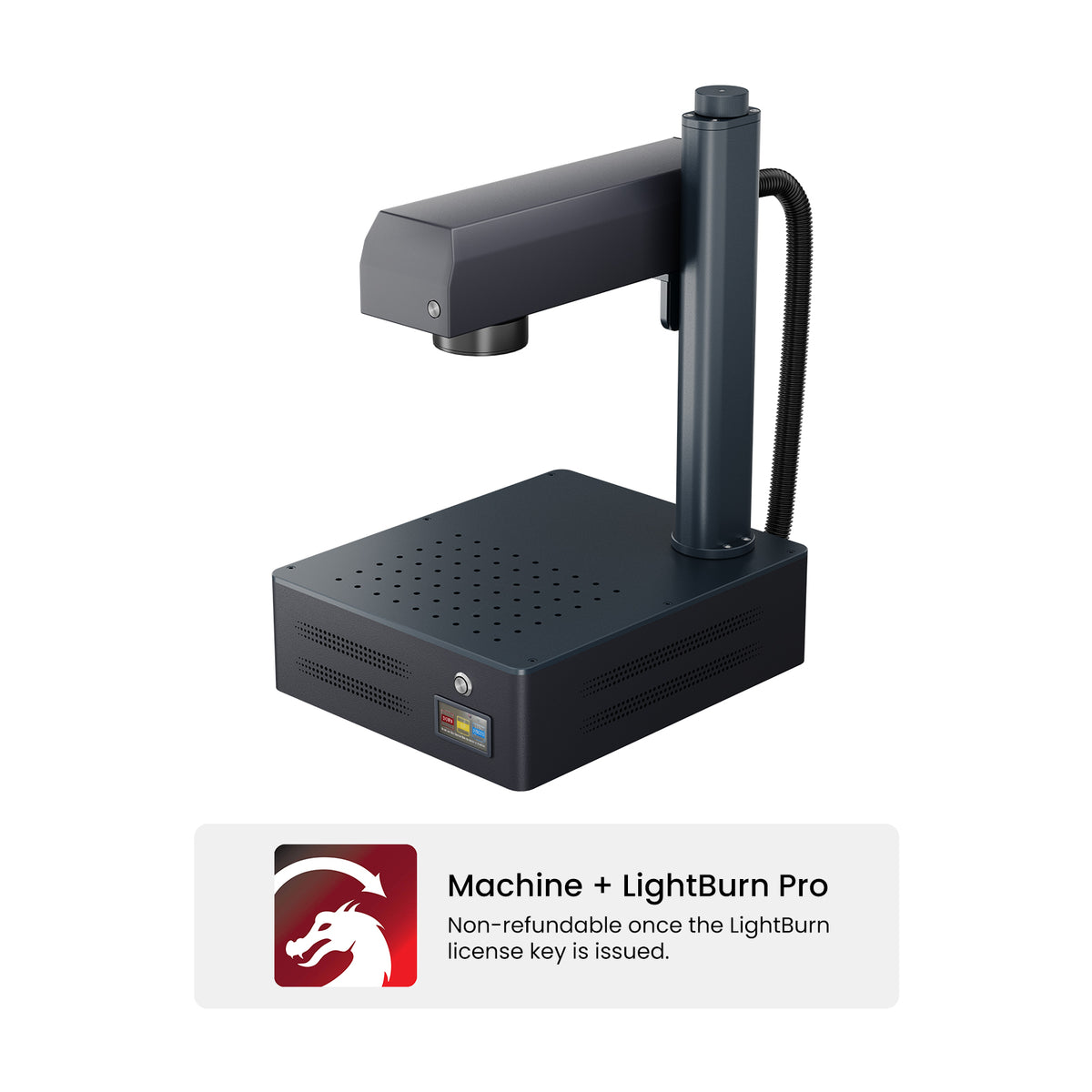
Monport Canada’s fiber-laser range is aimed at metal marking and engraving projects, not industrial sheet cutting, production welding or dedicated laser cleaning. Two listed options illustrate different needs: a compact 20W portable model for marking work and an integrated 30W MOPA model for users who want adjustable pulse control.
| Monport model | Manufacturer-listed details | Potential fit | Selection note |
|---|---|---|---|
| 20W Portable Fiber Laser Engraver for Color Metal Marking-JP | 20W; listed accuracy of 0.01 mm; maximum engraving speed up to 15,000 mm/s; metal, plastic and stone applications | Compact marking, personalization and colour-marking projects | The listed maximum speed is not a guaranteed job cycle time; confirm the material and required finish |
| GM 30W Pro Integrated JPT MOPA Fiber Laser Engraver | 30W JPT MOPA; 175 × 175 mm area; 2–500 ns pulse width; 1–4,000 kHz frequency; one-touch autofocus; listed maximum speed up to 10,000 mm/s and 0.01 mm accuracy | Metal marking and engraving where adjustable pulse control and a larger listed work area are useful | The 175 × 175 mm area and 2–500 ns range apply to the GM30 MOPA variant, not every GM Pro configuration |
The 20W product page lists up to 15,000 mm/s and 0.01 mm accuracy for the portable model (Monport 20W Portable Fiber Laser Engraver). The GM product page lists the GM30 MOPA variant with a JPT source, a 175 × 175 mm engraving area and adjustable 2–500 ns pulse width (Monport GM 30W Pro Integrated JPT MOPA Fiber Laser Engraver). These are manufacturer-published specifications, not independent test results. Actual throughput depends on the design, material, required depth, pass count, focus and workholding.
If your work centres on metal identification, personalized products, jewelry or small-batch engraving, explore the Monport Canada Fiber Laser Engraver collection. Compare the 20W portable model with the GM 30W MOPA according to the materials and finishes you expect to process. Neither should be selected as a replacement for a purpose-built industrial cutting, welding or cleaning system.
Frequently Asked Questions About Fiber Laser Applications
What are the main applications of a fiber laser?
Common applications include metal marking, engraving, annealing, selected colour marking, industrial cutting and welding, surface cleaning, drilling and specialized micromachining. The source and complete machine configuration determine which processes are supported.
Can a fiber laser cut metal?
Yes. Industrial fiber-laser cutting systems can cut compatible metals when equipped with a suitable source, cutting head, assist-gas supply and motion platform. A desktop pulsed fiber engraver is designed for marking and engraving, not sheet-metal cutting.
What is the difference between fiber laser marking and engraving?
Marking changes the surface appearance or creates a contrast mark; it may involve oxidation, surface structuring or shallow material removal. Engraving removes material to create a recessed feature. Because industry terminology can vary, specify the required depth and finish when discussing a job.
What is a MOPA fiber laser used for?
A MOPA fiber laser is a pulsed architecture that can provide independent control of pulse width and frequency on suitable sources. This flexibility can help with selected surface effects, dark marking and colour-marking work. The result still depends on the metal, finish and process conditions.
Can a desktop fiber laser engraver weld or clean metal?
Not unless it is specifically designed and configured for that process. Industrial laser welding and cleaning require dedicated sources, optics, process controls and safety systems. A desktop marking machine should not be treated as a welding or cleaning platform.
Does higher wattage always mean faster engraving?
No. Power is one factor. Pulse characteristics, beam quality, focus, scan speed, line spacing, material, required depth and the number of passes all affect the finished result and cycle time. Compare machines using the actual job you need to produce, not wattage alone.
Conclusion: Match the Fiber Laser to the Job
Fiber laser applications range from permanent product identification to advanced industrial processing. Desktop fiber engravers are a focused option for metal marking, engraving and personalization. Cutting, welding, cleaning, drilling and additive manufacturing require systems designed for those specific processes. Start with the material and required result, then compare the source, optics, working area, workflow and safety features. For metal marking and small-batch engraving, review Monport’s Canadian fiber laser collection and choose the configuration that matches the work you actually plan to produce.